

When comparing malleable iron vs ductile iron, it’s important to recognize the unique properties and applications of each material. Malleable iron is known for its excellent ductility and ability to withstand stress, making it ideal for applications requiring complex shapes and forms, such as pipe fittings and agricultural machinery. In contrast, ductile iron, also known as spheroidal graphite iron, offers superior strength and impact resistance, making it suitable for heavy-duty applications like automotive components and construction materials. Both malleable iron and ductile iron play crucial roles in various industries, but the choice between them ultimately depends on the specific mechanical requirements and operational conditions of the intended application.
Malleable iron vs ductile iron: The two forms of cast iron are commonly utilized in diverse industrial applications. In this post, we will look at the distinctions between these two forms, as well as their qualities, applications, and benefits.
Malleable iron vs Ductile iron
Ductile Cast Iron Properties
Nodular cast iron, commonly known as ductile cast iron, is a form of cast iron distinguished by its nodular graphite structure. This structure offers ductile cast iron its distinct qualities, such as high strength, flexibility, and corrosion resistance.
Ductile cast iron has more carbon than malleable cast iron, making it more resistant to wear and tear. It also has a lower melting point, which makes casting and machining easier.
Malleable Cast Iron Properties
The flaky graphite structure of malleable cast iron, on the other hand, distinguishes it. This structure confers special features on malleable cast iron, such as great machinability, corrosion resistance, and durability.
Malleable cast iron contains less carbon than ductile cast iron, making it less resistant to wear and strain. It does, however, have a greater melting point, making it more suitable for applications requiring high heat resistance.
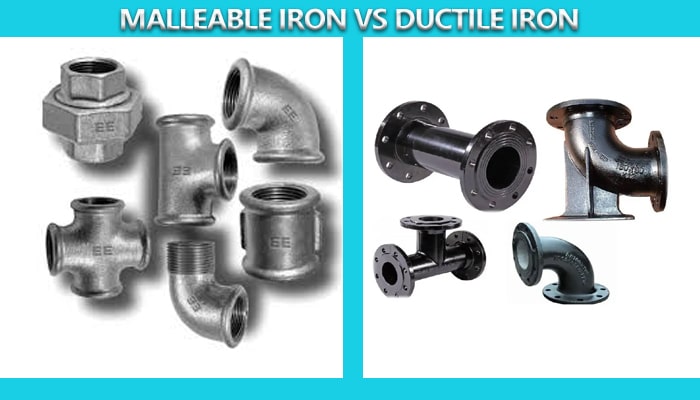
Ductile Iron vs Malleable Iron: Applications, Benefits, and Key Differences
Ductile cast iron and malleable cast iron are two widely used materials in industrial manufacturing and engineering. Although both belong to the cast iron family, they differ significantly in microstructure, mechanical properties, and typical applications.
Understanding the difference between malleable iron vs ductile iron is essential for engineers, manufacturers, and procurement teams when selecting the most suitable material for specific operating conditions.
Ductile Cast Iron Applications
Ductile cast iron is often utilized in applications that require high strength, excellent toughness, and good fatigue resistance.
It is commonly used in the manufacturing of:
- Gears and gear housings
- Bearings and mechanical components
- Pump bodies and valve bodies
- Heavy-duty machinery parts
In the automotive industry, ductile cast iron plays a critical role in producing:
- Engine blocks
- Cylinder heads
- Crankshafts
- Suspension components
These parts must withstand continuous mechanical stress, vibration, and thermal cycles. The nodular graphite structure of ductile cast iron allows it to absorb impact energy without cracking, making it ideal for high-load and high-reliability environments.
Malleable Cast Iron Applications
Malleable cast iron, on the other hand, is widely used in applications that require good machinability, dimensional accuracy, and smooth surface finishes.
Typical applications include:
- Pipe fittings and couplings
- Valves and connectors
- Electrical fittings
- Hardware components
In the construction industry, malleable cast iron is commonly used to manufacture:
- Door hinges
- Door knobs
- Decorative fittings
- Structural fasteners
Its ability to be easily machined makes malleable cast iron especially suitable for complex shapes and threaded components.
The Benefits of Ductile Cast Iron
Ductile cast iron offers several advantages over malleable cast iron, particularly in structural and mechanical performance.
Its main benefits include:
- Higher tensile strength
- Superior ductility and toughness
- Better fatigue resistance
- Strong impact absorption
In addition, ductile cast iron generally has better corrosion resistance than traditional cast iron and maintains mechanical stability under dynamic loading.
From a manufacturing perspective, ductile cast iron is also more efficient to produce on a large scale and often offers a better balance between performance and cost in heavy-duty applications.
Furthermore, ductile cast iron typically provides a longer service life than malleable cast iron, making it more suitable for long-term durability requirements.
The Benefits of Malleable Cast Iron
Malleable cast iron provides its own unique advantages, especially in precision-oriented applications.
Its main benefits include:
- Excellent machinability
- Good dimensional stability
- Smooth surface finish
- Strong resistance to deformation
Because malleable cast iron has a relatively higher melting point compared to ductile cast iron, it can also perform better in applications involving moderate heat exposure.
In many cases, malleable cast iron is considered more cost-effective for small and medium-sized components, especially where complex machining is required.
Malleable Iron vs Ductile Iron: Technical Comparison
| Property | Ductile Cast Iron | Malleable Cast Iron |
|---|---|---|
| Graphite structure | Nodular (spheroidal) | Temper carbon (flaky clusters) |
| Tensile strength | High | Medium |
| Ductility | Excellent | Moderate |
| Impact resistance | Very high | Medium |
| Machinability | Good | Excellent |
| Heat resistance | Medium | Higher |
| Typical applications | Engines, gears, heavy machinery | Pipe fittings, valves, hardware |
| Cost efficiency | Better for large components | Better for small components |
| Service life | Long | Medium to long |
This comparison highlights that malleable iron vs ductile iron is not about which material is “better,” but which one is more suitable for a specific engineering purpose.
Microstructure and Mechanical Behavior
The key difference between ductile and malleable cast iron lies in their internal microstructure.
Ductile cast iron contains nodular graphite, which distributes stress evenly across the material. This structure prevents crack propagation and enhances toughness.
Malleable cast iron contains irregular temper carbon particles, which allow good plastic deformation but provide less resistance to high impact loads.
These structural differences explain why ductile iron is preferred for high-stress environments, while malleable iron is favored for precision machining.
Industrial Selection Considerations
When choosing between ductile and malleable cast iron, engineers typically evaluate:
- Mechanical load requirements
- Operating temperature
- Corrosion exposure
- Machining complexity
- Component size
- Budget constraints
For structural components and pressure-bearing systems, ductile cast iron is usually the first choice.
For fittings, connectors, and threaded parts, malleable cast iron often provides better manufacturing efficiency.
Conclusion
Today we discussed the difference between Malleable iron vs Ductile Iron from both technical and application perspectives.
Ductile cast iron is characterized by its nodular graphite structure and is widely used in applications requiring high strength, excellent ductility, and long-term durability.
Malleable cast iron, on the other hand, offers superior machinability and is commonly used for pipe fittings, valves, and hardware components with precise dimensional requirements.
By understanding the mechanical properties and structural differences between these two materials, manufacturers and engineers can select the most suitable solution for their specific industrial needs, ensuring optimal performance, safety, and cost efficiency.