

Malleable iron pipe fittings are engineered components used to change the direction, branch pipelines, connect sections, or adapt pipe sizes across mechanical piping systems. Unlike rigid, brittle cast iron, malleable iron is heat-treated to produce a ductile microstructure that combines strength, impact resistance, and ease of machining — qualities that have kept these fittings relevant in plumbing, fire protection, industrial piping, and infrastructure projects worldwide.
This article provides a non-technical industry overview of malleable iron pipe fittings, their manufacturing logic, performance characteristics, application areas, standards compliance, and best practices for design and procurement. Insights are drawn from the 2022 Catalog of Jianzhi Malleable Iron Pipe Fittings, which remains a benchmark reference in the field.
What Makes Malleable Iron Pipe Fittings Unique?
Manufacturing and Metallurgy
Malleable iron starts as high-carbon white iron, which is heat-treated (annealed) over an extended period. This thermally transforms the carbon into temper graphite nodules within a ferritic and pearlitic matrix.
The resulting metal structure delivers:
- Improved ductility and toughness, which resists cracking
- Better mechanical performance under dynamic load
- Stable threaded surfaces for reliable sealing
- Enhanced machinability compared to traditional cast iron
This unique combination means malleable iron pipe fittings can bridge the gap between cast iron and forged steel in threaded applications.
Typical Products
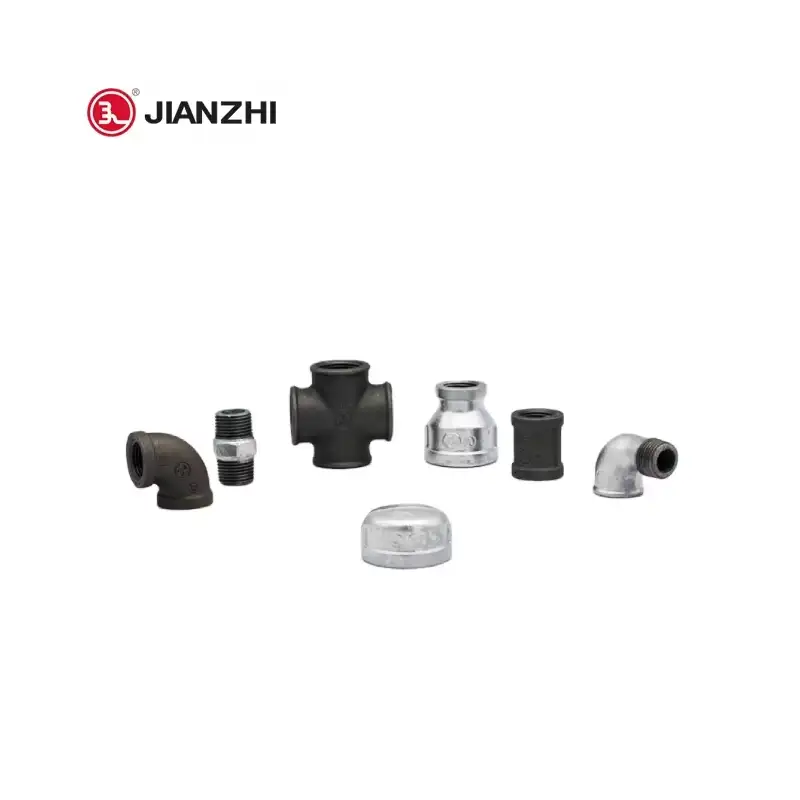
The industry catalog includes components such as:
- Elbows (45° and 90°)
- Tees and Crosses
- Couplings and Unions
- Nipples
- Bushings
- Caps and Plugs
- Reducers
Each component serves a specific purpose in routing, adapting, or terminating pipe runs.
How Malleable Iron Performs in Piping Systems
Malleable iron pipe fittings are valued for stable mechanical properties and dimensional reliability. Their threaded engagement ensures a tight joint without welding or special tools.
Advantages in practical use include:
- Secure threaded connections that minimize leakage
- High tensile strength for moderate-pressure systems
- Consistent quality from standardized production
- Compatibility with common pipe schedules and thread standards (BSP, NPT, ISO Metric)
These benefits contribute to their continued use in commercial facilities, manufacturing plants, and municipal distribution networks, where reliability and ease of assembly matter.
Standards and Compliance
Dimension and mechanical performance are governed by international standards such as:
| Standard | Scope |
|---|---|
| ASTM A197 | Standard Specification for Cupola Malleable Iron |
| ISO 4144 | Pipes and Fittings of Stainless Steel and Malleable Iron |
| BS EN 10242 | Threaded Pipe Fittings for General Purposes |
Compliance with these standards ensures that fittings can be paired with compatible global piping systems, facilitating international procurement and project planning.
Typical Use Cases in the Field
Malleable iron pipe fittings remain widely used in:
Commercial Plumbing
In large commercial buildings, threaded fittings facilitate distribution of water and compressed air lines. Their modular nature simplifies installation in confined mechanical rooms.
Fire Protection Systems
Fire sprinkler systems require reliable joints capable of withstanding intermittent high pressure. Malleable iron fittings offer a balance of strength and thread precision critical to safety compliance.
HVAC and Mechanical Installations
In heating, ventilation, and air conditioning lines, malleable iron assists in adapting pipe runs and addressing directional changes without expensive welding.
Industrial and Infrastructure Systems
Light industrial applications, plant utilities, and mid-pressure fluid networks often leverage malleable iron where cost and performance strike an optimal balance.
Engineering Selection Criteria
When selecting malleable iron pipe fittings, consider:
Pressure Rating
Fittings must match the operating pressure of the pipeline. Most malleable iron fittings serve moderate-pressure contexts (e.g., water and gas distribution).
Thread Specification
Ensure compatibility with pipe thread standards used in the project (BSP vs. NPT, etc.). Mismatched threads lead to leakage or joint failure.
Corrosion Considerations
While malleable iron performs well under normal conditions, corrosive environments may require protective coatings (e.g., galvanizing) or alternative materials.
Size and Tolerance Precision
Dimensional precision supports reliable assembly. Loose tolerances increase sealing issues; overly tight tolerances complicate installation.
Installation Best Practices
Correct installation improves performance and longevity:
- Clean both male and female threads from debris
- Use proper sealants or PTFE tape
- Avoid over-torquing, which can damage threads
- Support pipe runs to reduce stress on joints
Threaded connections should remain accessible for inspection and maintenance.
Cost and Lifecycle Considerations
Price per unit is only one component of total cost. Malleable iron fittings often deliver strong lifecycle value due to predictable performance and reduced need for replacement over time.
Compared with some private-brand or low-grade alternatives, certified malleable iron fittings typically require fewer field adjustments and injections of sealant post-installation.
Common Misconceptions
“Malleable Iron Is Obsolete”
Despite growth in welded SS and forged solutions, malleable iron remains relevant for specific applications where threaded assembly, moderate pressure, and cost efficiency are prioritized.
“Threads Leak More than Welded Joints”
Properly machined and sealed threaded joints, when installed according to best practices, deliver reliable leak resistance for their design range.
FAQ – Quick Answers for Procurement and Engineering Teams
Q: Can malleable iron fittings be used for gas lines?
A: Yes, in many regions. Always verify with local codes and pressure ratings.
Q: Are malleable iron fittings suitable for outdoor installation?
A: Yes if adequately protected (e.g., galvanized coatings).
Q: Do they require special torque tools?
A: Standard torque wrenches with proper settings are recommended to avoid thread damage.
Q: How do they compare to ductile iron?
A: Ductile iron offers higher tensile strength and is often used in buried pipe systems; malleable iron excels in threaded, above-ground applications.
Q: What maintenance do they need?
A: Periodic inspection; re-torquing is usually not necessary unless system conditions change.
Final Summary
Malleable iron pipe fittings continue to hold an important niche in mechanical and infrastructure piping due to their balance of ductility, mechanical strength, threaded precision, and cost-effectiveness. Properly specified and installed, they support reliable systems across plumbing, fire protection, HVAC, and plant utilities. For decision-makers in engineering and procurement, a clear understanding of material properties, standards compliance, and application context is essential for optimal system performance.
Reference
Jianzhi Malleable Iron Pipe Fittings 2022 Catalog
https://www.jianzhipipefitting.com/wp-content/uploads/2022/06/Catalog-Jianzhi-Malleable-Iron-Pipe-Fittings-2022.pdf
Wikipedia – Pipe Fitting
https://en.wikipedia.org/wiki/Pipe_fitting
ASTM A197 Standard
https://www.astm.org/Standards/A197.htm