

Abstract
An examination of black versus galvanized malleable iron pipe fittings reveals a fundamental divergence in application based on surface treatment and its resultant properties. Black malleable iron fittings, characterized by their uncoated, heat-formed iron oxide surface, are suited primarily for anhydrous environments, such as natural gas and oil transmission lines. Their lack of a protective coating renders them highly susceptible to oxidation when exposed to water. Conversely, galvanized malleable iron fittings are coated with a layer of zinc, typically through a hot-dip process. This zinc layer provides sacrificial cathodic protection against corrosion, making these fittings the appropriate choice for potable water systems, drainage, and applications exposed to atmospheric moisture. The selection between the two is not a matter of preference but a critical engineering and safety decision. Misapplication, such as using black iron for water or galvanized fittings for gas, can lead to premature system failure, property damage, and significant safety hazards, including leaks of flammable gas or contaminated water.
Key Takeaways
- Use galvanized malleable iron fittings for all water, steam, and outdoor projects.
- Select black malleable iron fittings exclusively for gas and oil line installations.
- Never use galvanized fittings for gas lines to prevent zinc flaking and clogging.
- Avoid mixing black and galvanized fittings to prevent accelerated galvanic corrosion.
- The choice in the black vs galvanized malleable iron pipe fittings debate impacts safety.
- Always verify fittings meet project standards like NPT or BSPT for compatibility.
- Consult a professional for gas line installations to ensure safety and compliance.
Table of Contents
- The Foundational Choice in Piping Systems
- 1. The Fundamental Difference: Surface Coating and Manufacturing
- 2. Corrosion Resistance: The Deciding Factor for Longevity
- 3. Application Suitability: Where Each Fitting Shines (and Fails)
- 4. Economic Considerations: Balancing Upfront Cost with Lifetime Value
- 5. Installation and Safety Protocols: Beyond the Material
- Frequently Asked Questions (FAQ)
- Conclusion
- References
The Foundational Choice in Piping Systems
When we approach the construction of any fluid or gas conveyance system, the materials we choose form the very bedrock of its integrity and longevity. Among the most durable and time-tested materials are malleable iron pipe fittings. Produced from cast iron that has undergone a specific heat treatment to grant it ductility, these components are renowned for their strength and resilience (Jianzhi pipe fittings, 2023). However, a crucial distinction exists within this category that dictates their proper use: the choice between black and galvanized finishes. This is not a mere aesthetic consideration; it is a decision with profound implications for safety, durability, and function. The debate of black vs galvanized malleable iron pipe fittings is a central topic for plumbers, engineers, and even discerning DIY enthusiasts.
Malleable iron itself is a fascinating material. It begins as brittle white cast iron, which is then annealed—a process of heating and controlled cooling—to transform its internal carbon structure. This treatment changes the brittle carbides into nodules of graphite, imbuing the iron with the ability to deform under stress without fracturing, a property known as malleability or ductility (Jianzhi pipe fittings, 2022). This makes it an ideal material for threaded pipe fittings, which must endure the mechanical stress of being tightened into a system. Leading manufacturers provide a vast array of these components, from elbows and tees to unions and flanges, ensuring a solution for nearly any piping configuration.
The divergence occurs after the fitting is cast and formed. It can either be left with its natural finish or undergo a secondary process of galvanization. The path chosen at this stage determines the fitting’s destiny. One path leads to a life carrying natural gas in the walls of a home, while the other is destined for a life transporting water or withstanding the rain in an outdoor structure. To understand why this is, we must delve into the specific properties imparted by each finish. The following comparative table provides a high-level overview of the core differences, which we will explore in greater detail.
Comparative Analysis: Black vs. Galvanized Malleable Iron Fittings
| Feature | Black Malleable Iron Fittings | Galvanized Malleable Iron Fittings |
|---|---|---|
| Coating | None (Iron oxide scale from manufacturing) | Hot-dipped zinc coating |
| Primary Use | Natural gas, propane, and oil lines | Water lines (potable and non-potable), outdoor use, steam |
| Corrosion Resistance | Low; rusts quickly when exposed to water | High; zinc provides sacrificial protection |
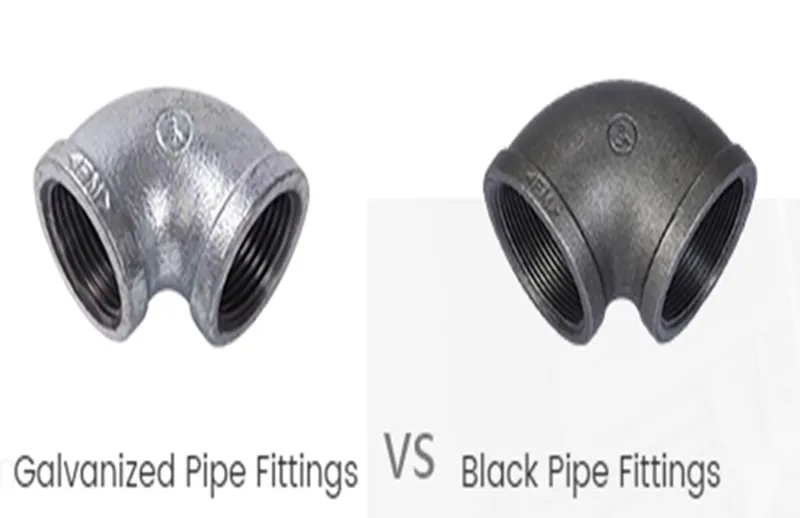
| Appearance | Dark, black or greyish, slightly rough surface | Silvery-grey, can be shiny or matte, may have a spangled pattern |
| Cost | Generally less expensive | Generally more expensive due to the galvanizing process |
| Health & Safety | Unsafe for potable water due to rust | Safe for potable water; unsafe for gas lines due to potential zinc flaking |
1. The Fundamental Difference: Surface Coating and Manufacturing
At the heart of the black vs galvanized malleable iron pipe fittings discussion lies the manufacturing process itself. Both fittings start their life from the same robust, ductile material, but a crucial final step sets them on divergent paths of purpose and performance. To make an informed choice, one must first appreciate the nature of their respective surfaces.
Understanding Black Malleable Iron Fittings
The term “black” pipe fitting is somewhat of a misnomer, as it doesn’t refer to a paint or a deliberate coating applied for color. Instead, the dark finish is a byproduct of the manufacturing process. During the high-temperature forging and annealing that gives malleable iron its desirable properties, a layer of dark iron oxide, specifically magnetite (Fe3O4), forms on the surface of the fitting. This is often referred to as mill scale.
This dark, scaly surface is what gives the fitting its characteristic “black” appearance. It offers a very minimal degree of corrosion resistance, essentially just enough to prevent flash rusting during storage and transport. However, it provides no long-term protection against oxidation, especially in the presence of moisture. Some black pipe fittings are also coated with a light protective oil to further inhibit rust prior to installation. The primary function of this type of fitting is not to resist external corrosion but to safely contain substances that are not corrosive to iron, such as natural gas and certain oils. The aesthetic is often described as industrial or rustic, making it a popular choice for furniture and decorative projects where it will not be exposed to water.
The Galvanization Process Explained
Galvanization is a method of applying a protective zinc coating to iron or steel to prevent rusting. The most common method used for pipe fittings is hot-dip galvanization, a process that has been refined for over 150 years. The process, as outlined by the American Galvanizers Association (2022), involves several meticulous steps.
First, the base malleable iron fitting must be thoroughly cleaned to ensure the zinc will adhere properly. This is a multi-stage process that typically includes:
- Degreasing/Caustic Cleaning: To remove organic contaminants like dirt, oil, and grease.
- Rinsing: To remove the cleaning solution.
- Acid Pickling: The fitting is submerged in a vat of acid, usually sulfuric or hydrochloric acid, to remove the mill scale (the same iron oxide found on black pipe) and any rust.
- Fluxing: The fitting is then dipped in a flux solution, often zinc ammonium chloride, which prevents new oxides from forming on the cleaned surface and promotes the bonding of zinc to the iron.
After this preparation, the fitting is completely immersed in a bath of molten zinc heated to approximately 840°F (449°C). The iron and zinc react metallurgically, forming a series of zinc-iron alloy layers, with a final outer layer of pure zinc. When withdrawn from the kettle, this coating solidifies into a durable, abrasion-resistant, and highly corrosion-resistant shield.
Visual and Tactile Identification
Distinguishing between the two is straightforward. Black malleable iron fittings are, as the name suggests, dark in color, ranging from a matte black to a dark grey. The surface can feel slightly rough or scaly to the touch.
Galvanized malleable iron fittings, in contrast, have a distinct silvery-grey appearance. The finish can be either bright and shiny or a duller matte grey, depending on the cooling rate and composition of the zinc bath. Often, the surface will exhibit a crystalline, snowflake-like pattern known as “spangle,” which is characteristic of the zinc solidification process. The surface can feel smoother than black iron, but it may also have small bumps or a slightly uneven texture dueto the nature of the hot-dip coating. This visual and tactile difference is the most immediate indicator of the fitting’s intended purpose and corrosion resistance capabilities.
Application Suitability Based on Finish
| Application | Recommended Fitting Type | Rationale |
|---|---|---|
| Natural Gas Piping | Black Malleable Iron | No risk of rust from the medium. Avoids zinc flaking issues. |
| Potable Water Lines | Galvanized Malleable Iron | Zinc coating prevents rust and contamination of drinking water. |
| Outdoor Railings | Galvanized Malleable Iron | High corrosion resistance needed to withstand rain, snow, and humidity. |
| Industrial Steam Lines | Galvanized Malleable Iron | Resists corrosion from steam and condensate. |
| DIY Furniture (Indoor) | Black Malleable Iron | Cost-effective and provides a popular industrial aesthetic. Sealing is recommended. |
| Fire Sprinkler Systems | Galvanized or Black (depending on code) | Often galvanized for wet systems; sometimes black for dry systems. UL/FM certification is key. |
2. Corrosion Resistance: The Deciding Factor for Longevity
The long-term performance of a piping system is inextricably linked to its ability to resist corrosion. This single factor is the most compelling reason for the strict division of labor between black and galvanized fittings. The environment within and outside the pipe dictates the rate of degradation, and choosing the wrong material can lead to a cascade of failures, from minor leaks to catastrophic structural collapses. The contest of black vs galvanized malleable iron pipe fittings is won or lost on the battlefield of electrochemistry.
The Achilles’ Heel of Black Iron: Rust
Iron, the primary constituent of black pipe fittings, has a natural tendency to return to its most stable chemical state: iron oxide. This process, which we commonly call rust, is an electrochemical reaction that requires two things: oxygen and water. When a black iron fitting is exposed to moisture, whether in the form of liquid water, condensation, or even high ambient humidity, the iron atoms on the surface begin to give up electrons (oxidation). These electrons flow to another site on the iron, where they react with oxygen and water to form hydroxide ions (reduction). The iron ions and hydroxide ions then combine to form hydrated iron oxide, a flaky, reddish-brown substance that we know as rust.
This rust layer is porous and brittle. It does not protect the underlying iron from further corrosion. Instead, it flakes off, exposing fresh iron to the elements, and the cycle continues. In a water pipe, this process has two disastrous consequences. First, the rust contaminates the water, turning it brown and imparting a metallic taste, making it non-potable. Second, the pipe wall itself is gradually eaten away, thinning over time until it can no longer contain the pressure, leading to leaks and eventual failure. This is why black iron pipe is unequivocally unsuitable for carrying water. Its use in such an application is not just a poor choice; it is a guarantee of future failure.
The Sacrificial Shield of Galvanization
The genius of galvanization lies in a principle called cathodic protection. Zinc is a more electrochemically active metal than iron. This means that when both metals are present in an electrolyte (like water), the zinc will corrode preferentially to the iron. The zinc coating acts as a “sacrificial anode.”
When a scratch or a small break in the galvanized coating exposes the underlying iron, a tiny electrochemical cell is created. The zinc surrounding the break becomes the anode and corrodes, giving up its electrons to protect the exposed iron, which becomes the cathode. The zinc effectively sacrifices itself to keep the iron intact. This protection continues as long as there is zinc remaining in the vicinity of the exposed area.
Beyond this sacrificial protection, the zinc coating provides a simple barrier. The layer of zinc and zinc-iron alloys physically separates the iron from the corrosive environment. Furthermore, the corrosion products of zinc are different from those of iron. Zinc corrodes at a much slower rate than iron, and it forms a stable, adherent, and non-porous patina of zinc carbonate over time as it reacts with carbon dioxide in the air. This patina further slows the corrosion process, granting galvanized fittings a lifespan that can be many decades long, even in harsh outdoor environments (Schrader, 2019).
Environmental Impact on Corrosion Rates
It is important to recognize that “corrosion resistance” is not an absolute property. The lifespan of any fitting, galvanized or not, is highly dependent on its specific environment. For galvanized fittings, factors like air pollution (especially sulfur dioxide and chlorides), high humidity, constant wetness, and contact with acidic soil can accelerate the consumption of the zinc coating. In marine environments, the high concentration of salt in the air and water creates a highly corrosive environment that can overwhelm even a thick galvanized coating over time.
For black iron, any exposure to moisture is detrimental. An indoor gas line in a climate-controlled building may last indefinitely, showing little to no corrosion. However, the same black iron pipe used for a decorative shelf in a humid bathroom or a coastal home will begin to show signs of surface rust in a very short time. For decorative purposes, this might be a desired aesthetic, but it is a clear demonstration of its vulnerability. If that shelf were a structural element, its integrity would be compromised. The choice between black vs galvanized malleable iron pipe fittings, therefore, requires a thoughtful assessment of the intended service environment.
3. Application Suitability: Where Each Fitting Shines (and Fails)
The theoretical understanding of coatings and corrosion science finds its practical expression in the specific applications for which these fittings are designed. Adhering to these established uses is paramount for creating safe, reliable, and long-lasting systems. To deviate from these norms is to invite failure, often with consequences that range from inconvenient to dangerous. The clear delineation of roles is the most critical lesson in the study of black vs galvanized malleable iron pipe fittings.
The Domain of Black Iron: Gas and Oil Lines
Black malleable iron pipe fittings are the industry standard for the transmission of natural gas and propane within residential and commercial buildings. This may seem counterintuitive given their poor corrosion resistance, but the key is the nature of the substance they carry. Natural gas and propane are delivered with extremely low moisture content. In the absence of water, the primary catalyst for rust is missing. The iron pipe is therefore perfectly stable and will not corrode from the inside.
The use of black iron for this purpose is not merely a matter of tradition or cost. There is a critical safety reason why galvanized fittings are strictly prohibited for gas lines by most plumbing codes, including the International Fuel Gas Code (IFGC). The zinc coating on galvanized pipes, over time, can flake or peel off. These small zinc flakes can be carried downstream by the gas flow and have the potential to clog the tiny orifices in gas appliance regulators and control valves. A clogged regulator can fail in either an open or closed position, leading to a dangerous situation where an appliance either receives no gas or, far worse, receives unregulated high-pressure gas, creating a severe fire or explosion hazard (International Code Council, 2021). Therefore, for the safe conveyance of fuel gases, black iron is the only appropriate choice. Its use in oil lines is for similar reasons; the oil itself protects the interior of the pipe from any incidental moisture.
Galvanized Fittings for Water and Outdoor Use
The exact properties that make galvanized fittings unsuitable for gas make them perfect for water. The robust zinc coating provides the necessary barrier and sacrificial protection to prevent the pipe from rusting from the inside out when carrying water. This ensures that the water delivered remains clean and free from rust contamination, making galvanized malleable iron fittings suitable for potable (drinking) water lines. They are also used for non-potable water, drainage, and steam lines, where corrosion resistance is equally important for the longevity of the system.
Their ability to withstand atmospheric corrosion makes them the default choice for any outdoor application. This includes outdoor plumbing, structural elements like handrails and guardrails, scaffolding, fence posts, and industrial-style furniture intended for outdoor use. A black iron pipe used for an outdoor handrail would begin to rust and stain its surroundings after the first rain, and its structural integrity would degrade over time. A galvanized pipe in the same application will maintain its strength and appearance for many years, if not decades. A glance through a malleable iron fittings catalog will show a wide variety of shapes and sizes in a galvanized finish, testament to their versatility in these wet or exposed environments.
The Danger of Mixing and Matching
A common and costly mistake made by those unfamiliar with plumbing principles is connecting dissimilar metals directly. Specifically, connecting a black iron or steel pipe directly to a galvanized iron pipe in a water system creates a phenomenon known as galvanic corrosion, and it happens on an accelerated schedule.
As we discussed, when two different metals are in contact in the presence of an electrolyte (water), they form a galvanic cell. In this case, the zinc coating of the galvanized pipe is the anode, and the black iron pipe is the cathode. The zinc will corrode sacrificially to protect the iron, which is exactly what it is supposed to do. However, the problem is the scale. The large surface area of the black iron pipe acts as a very large cathode, dramatically accelerating the corrosion of the much smaller area of zinc at the connection point.
The result is that the zinc coating on the galvanized fitting will be rapidly eaten away right at the joint, leading to a premature and aggressive leak in a matter of months or a few years, rather than decades. The joint becomes the weakest point in the entire system. To prevent this, when a transition between galvanized steel and another metal (like black iron in a non-water system, or more commonly, copper in a water system) is necessary, a special fitting called a dielectric union must be used. A dielectric union incorporates a plastic or rubber insulator that physically separates the two metals, breaking the electrical circuit and preventing the flow of ions that causes galvanic corrosion. Ignoring this small detail can doom an entire plumbing project to failure.
4. Economic Considerations: Balancing Upfront Cost with Lifetime Value
While safety and functionality are the primary drivers in the black vs galvanized malleable iron pipe fittings decision, cost is an unavoidable and practical consideration for any project. However, a simplistic comparison of the initial price tag can be misleading. A more sophisticated analysis requires an examination of the total cost of ownership, which accounts for not only the purchase price but also the expected lifespan, maintenance requirements, and the cost of potential failure.
A Tale of Two Price Tags
On a direct, per-fitting basis, black malleable iron fittings are almost always less expensive than their galvanized counterparts. The reason for this is straightforward: manufacturing a black iron fitting involves fewer steps. Once the fitting is cast, threaded, and inspected, it is essentially complete, perhaps receiving a light oil coating before being boxed.
A galvanized fitting, on the other hand, must go through the entire multi-stage hot-dip galvanizing process after it is formed. This process involves significant inputs: large vats of cleaning chemicals and acids, the energy required to keep a massive kettle of zinc molten, the cost of the zinc itself, and the additional labor and handling required. These additional manufacturing costs are passed on to the consumer, resulting in a higher upfront price for galvanized fittings. For a large project with hundreds or thousands of fittings, this initial cost difference can be substantial. This might tempt a budget-conscious builder to choose the cheaper option, but without considering the application, this is a classic example of being “penny wise and pound foolish.”
Calculating the Total Cost of Ownership
The concept of Total Cost of Ownership (TCO) is crucial here. TCO evaluates the full lifecycle cost of a product, not just its initial purchase price. Let us consider two scenarios:
Scenario 1: A Natural Gas Line. In this application, a black iron fitting is the correct choice. It will perform its function safely for the life of the building with no maintenance. A galvanized fitting would be slightly more expensive upfront and would introduce a safety risk. Therefore, in this case, the lower upfront cost of the black iron fitting also corresponds to the lowest TCO.
Scenario 2: A Potable Water Line. Here, the analysis is starkly different. A black iron fitting might be 20-30% cheaper at the hardware store. However, it will begin to rust immediately. Within a few years, it could fail, causing a leak. The cost of this failure is not just the price of a new fitting. It includes the cost of the water damage to drywall, flooring, and furnishings; the labor cost to access the pipe (which may be behind a wall), repair the leak, and then repair the wall; and the potential for mold growth. If the failure occurs multiple times, the costs multiply.
Conversely, the more expensive galvanized fitting, when correctly installed, will last for 50 years or more (Jianzhi pipe fittings, 2023). Its higher initial cost is an investment in longevity and reliability. When you divide that higher initial cost by its decades-long service life and factor in the near-zero cost of maintenance or failure, the TCO of the galvanized fitting in a water application is dramatically lower than that of the black iron fitting. The initial savings from using the wrong part are dwarfed by the eventual cost of its inevitable failure.
Market Fluctuations and Availability
The price difference between the two types of fittings is not static. The London Metal Exchange (LME) price of zinc, a globally traded commodity, can fluctuate based on supply, demand, and geopolitical factors. A significant spike in zinc prices will inevitably lead to a corresponding increase in the cost of galvanized products. However, both black and galvanized malleable iron fittings are staple products for the plumbing and construction industries. They are widely available from a global network of distributors and supplied by numerous leading pipe fitting manufacturers that produce fittings to various international standards, including NPT (National Pipe Thread, common in the US) and BSPT (British Standard Pipe Taper, common in Europe). While regional availability might vary slightly, a professional should have no trouble sourcing the correct type of fitting for any given job. The choice should be driven by the application, not by a temporary price fluctuation or a minor difference in availability.
5. Installation and Safety Protocols: Beyond the Material
The successful implementation of a piping system extends beyond selecting the correct material. Proper installation techniques and an unwavering commitment to safety are essential to realize the full potential of either black or galvanized malleable iron fittings. While the materials themselves are different, they share a common heritage of threaded assembly, and both demand a high degree of care, particularly when dealing with flammable gases or potable water.
Threading and Sealing: Common Ground
Both black and galvanized malleable iron fittings rely on tapered pipe threads for both mechanical connection and sealing. The most common standards are NPT in North America and BSPT in Europe and other parts of the world. These standards are not interchangeable, and it is critical to ensure that the pipe and fittings share the same thread type.
The tapered nature of the threads means that as the fitting is tightened, the flanks of the male and female threads are forced together, creating a strong mechanical joint. However, this metal-to-metal contact alone is not sufficient to create a perfect, leak-proof seal, especially under pressure. The helical path of the thread provides a potential channel for fluid or gas to escape.
To solve this, a proper thread sealant must be used. There are two primary types:
- PTFE Tape (Teflon Tape): A thin tape made of polytetrafluoroethylene that is wrapped around the male threads before assembly. It acts as a lubricant to prevent galling (threads seizing) and fills the small voids between the threads to create a seal.
- Pipe Dope (Pipe Joint Compound): A paste-like sealant that is brushed onto the male threads. It also lubricates the joint and contains solids and solvents that fill the gaps to prevent leaks.
The choice between them is often a matter of plumber preference and local code, although specific compounds are formulated for gas, water, or other chemicals. The key is that a sealant must be used, and it must be applied correctly (to the male threads only, leaving the first one or two threads bare to prevent sealant from entering the pipe). This procedure is identical for both black and galvanized fittings.
Critical Safety for Gas Lines (Black Iron)
Working with gas piping is not a task for the inexperienced. The consequences of a leak are not just water damage; they are fire and explosion. When installing a black iron gas line, safety is the absolute priority.
- Professional Installation: In most jurisdictions, gas piping work must be performed by a licensed and qualified professional. This is not a corner to be cut. Professionals understand the codes, the proper assembly techniques, and the critical testing procedures.
- Leak Testing: After any gas piping system is assembled, modified, or repaired, it must be thoroughly leak-tested before being put into service. This typically involves capping the end of the line, pressurizing the system with air or an inert gas (never oxygen) to a specified pressure using a gauge, and observing to see if the pressure holds for a designated period. Additionally, every single joint must be tested with a leak detection solution—essentially a specialized soapy water solution. If a leak is present, bubbles will form. Every joint, without exception, must be checked.
- Ventilation: All work should be done in a well-ventilated area, and the main gas supply must be shut off before beginning any work.
The integrity of a black iron gas line is a matter of life and safety, and the protocols surrounding its installation reflect that gravity.
Health and Safety for Water Lines (Galvanized)
While less immediately catastrophic than a gas leak, issues with water lines can have significant health and property implications.
- Legacy Systems and Lead: It is worth noting that while modern, newly manufactured galvanized fittings are safe for potable water, older galvanized plumbing systems installed before the 1980s can be a source of lead contamination. In the past, the zinc used for galvanizing sometimes contained lead as an impurity, or lead-based pipe dope was used on the threads. As these old pipes corrode, lead can leach into the drinking water. This is one reason why many older homes have had their galvanized plumbing replaced with copper or PEX. When working on an older home, it’s important to be aware of this potential hazard (Cornwell, 2016).
- Flushing the System: After installing a new water line using galvanized fittings, it is good practice to flush the system thoroughly. This will remove any residual cutting oils, excess pipe dope, or debris that may have entered the pipe during construction. Simply open the taps at the end of the line and let the water run for several minutes until it is clear.
- Preventing Galvanic Corrosion: As mentioned previously, a crucial safety and longevity step is to use dielectric unions whenever transitioning from galvanized pipe to a different metal like copper. This simple step prevents the accelerated corrosion that would otherwise destroy the joint.
Ultimately, the choice in the black vs galvanized malleable iron pipe fittings debate is the first step. Executing the installation with precision, knowledge, and a deep respect for the potential risks is what transforms a collection of parts into a safe and durable system.
Frequently Asked Questions (FAQ)
1. Can I use black malleable iron pipe fittings for a water line, even for a short time?
No, you should never use black malleable iron pipe fittings for any application involving water, not even temporarily. The material is uncoated iron, and it will begin to rust almost immediately upon contact with water and oxygen. This rust will contaminate the water, making it unsuitable for drinking, and will quickly corrode the fitting itself, leading to leaks and eventual system failure. The cost and damage from a leak far outweigh any initial savings.
2. Is it really that bad to use galvanized pipe fittings for a natural gas line?
Yes, it is extremely dangerous and is prohibited by plumbing and fuel gas codes in most places. The zinc coating on galvanized fittings can flake off over time. These small, hard flakes can travel with the gas flow and clog the small, precise orifices in appliance regulators and control valves. A clogged regulator can cause an appliance to malfunction dangerously, either by starving it of fuel or by allowing unregulated, high-pressure gas to flow, creating a significant fire or explosion risk. Always use black iron for gas.
3. What happens if I connect a black iron fitting directly to a galvanized pipe in my water system?
This will create a galvanic cell and cause accelerated corrosion. The zinc on the galvanized fitting will corrode rapidly to protect the black iron, and the connection joint will fail and leak in a much shorter time than expected, often within a few years or even months. To prevent this, you must use a dielectric union between the two different metals, which isolates them electrically and stops the corrosive reaction.
4. Can I paint black iron pipe fittings to use them outdoors or for water?
While painting a black iron fitting can provide a barrier against moisture and is a common practice for decorative projects like shelving, it is not a reliable method for long-term corrosion protection in a plumbing application. Any scratch, chip, or pinhole in the paint will expose the iron underneath, and rust will begin to form and creep under the surrounding paint. For any functional outdoor or water-based application, it is far safer and more effective to use the correct galvanized fitting from the start.
5. Why is it called “malleable” iron if it’s so strong and rigid?
The term “malleable” refers to the material’s properties during its formation and its ability to resist fracture compared to standard cast iron. Standard grey cast iron is very brittle and will shatter under sharp impact or high stress. Malleable iron, thanks to a specific heat-treatment process called annealing, has a different internal structure. This structure allows it to bend or deform slightly without breaking, giving it higher ductility and tensile strength. This “malleability” makes it much more durable and resistant to the mechanical stresses of shipping, handling, and installation.
6. How long do galvanized malleable iron fittings actually last?
The lifespan of a galvanized fitting depends heavily on its environment. In a typical indoor plumbing application with neutral pH water, they can easily last 50-70 years or more. Outdoors, the lifespan depends on factors like humidity, rainfall, and air pollution. In a mild rural environment, a galvanized handrail might last for over 75 years. In a harsh industrial or coastal marine environment, the zinc coating will be consumed faster, and the lifespan might be closer to 20-30 years.
7. Are threaded malleable iron fittings better than other connection types like soldering or push-to-connect?
Each connection type has its place. Threaded malleable iron fittings offer exceptional mechanical strength and are ideal for high-pressure applications and for systems like gas lines where heat from soldering is not permissible. They are robust and can be disassembled, though it can be difficult. Soldered copper is excellent for water lines and offers a smooth interior for better flow. Push-to-connect fittings are very fast and easy to install but may not have the same long-term durability or pressure rating as a properly threaded iron fitting. The best method depends on the specific application, code requirements, and the skill of the installer.
Conclusion
The deliberation over black vs galvanized malleable iron pipe fittings is not a matter of subjective preference but a foundational decision rooted in material science, chemistry, and safety engineering. The distinction is absolute: black iron, with its unadorned, heat-scaled surface, is the designated material for the moisture-free environments of gas and oil lines, where the absence of a zinc coating is a critical safety feature. Galvanized iron, fortified by its sacrificial zinc shield, is the mandatory choice for applications involving water, steam, or exposure to the elements, where its ability to resist corrosion ensures both the purity of the medium and the longevity of the system.
To disregard these established roles is to court failure. Using black iron for water invites rust, contamination, and leaks. Using galvanized fittings for gas introduces the unacceptable risk of clogged regulators and catastrophic failure. Mixing the two without dielectric protection initiates a rapid process of self-destruction through galvanic corrosion. The higher upfront cost of a galvanized fitting is a prudent investment in decades of trouble-free service, while the initial savings of using an incorrect black fitting are an illusion, erased by the far greater costs of subsequent repair and damage. The integrity of our infrastructure, from the water we drink to the gas that heats our homes, depends on this fundamental understanding. The choice is clear, and the consequences are real.
References
American Galvanizers Association. (2022). Hot-dip galvanizing process.
Cornwell, D. A. (2016). Contribution of galvanized plumbing to lead in drinking water. Water Research Foundation.
International Code Council. (2021). 2021 International Fuel Gas Code (IFGC).
Jianzhi pipe fittings. (2022, September 13). What are malleable cast iron threaded pipe fittings? Jianzhi Pipe Fittings. https://www.jianzhipipefitting.com/2022/09/13/what-are-malleable-cast-iron-threaded-pipe-fittings/
Jianzhi pipe fittings. (2023, June 8). Using malleable cast iron pipe fittings for plumbing. Jianzhi Pipe Fittings. https://www.jianzhipipefitting.com/2023/06/08/using-malleable-cast-iron-pipe-fittings-for-plumbing/
Schrader, K. (2019). The science behind hot-dip galvanizing. Finishing & Coating.